

Markus Jungmann Ceramics
“In the stillness of the Beara mountains, surrounded by the gentle beauty of the Kerry landscape, and sustained by the gracious warmth of the community, I feel driven to create something that communicates both the wonder I experience looking out the windows of my studio, and the profound gratitude I feel in being surrounded by such majesty. I am intrigued by the aesthetic potential of porcelain and work with glazes that bring out the simple beauty and translucency of the material juxtaposed with expressive and invigorating colour, brightening the dullest of days.”
Markus Jungmann is a ceramic artist working in porcelain from his studio in Ballygriffin, near Kenmare on Kerry's Wild Atlantic Way. Born in the Saarland in Germany, he trained in the German ceramics tradition — first at the Staatliche Fachschule für Keramik in Landshut, then at Höhr-Grenzhausen — before completing an MA in Ceramics at the University of Wales in 1992.
From 1993 to 2017 he lectured in Ceramics at the Crawford College of Art & Design in Cork, guiding generations of students across more than two decades of teaching while developing his own studio practice.
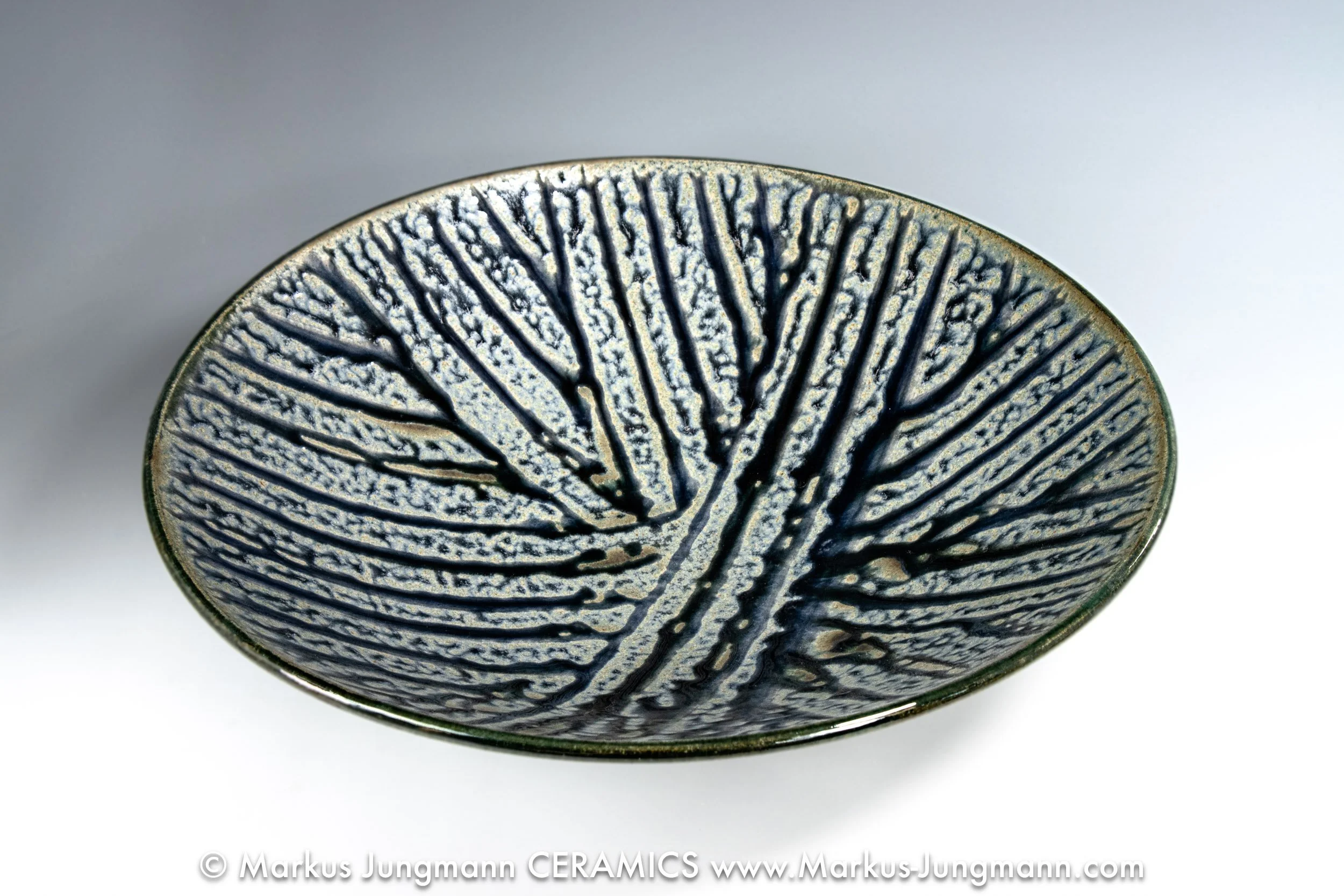
His work is wheel-thrown and high-fired, finished with feldspar, sang de boeuf and ash glazes that give each piece a distinctive surface. Alongside bespoke and collector pieces, he makes small series of contemporary tableware and unique monoprints drawn from photographs of his immediate surroundings and his travels. His work has been exhibited nationally — including at the National Design & Craft Gallery and the Royal Hibernian Academy — and internationally, and is held in galleries across Ireland.
In 2026 Markus Jungmann was selected for PORTFOLIO 2026/2027, the Design & Crafts Council Ireland's showcase of Ireland's leading contemporary makers. His work features in the PORTFOLIO publication (Autumn 2026) and in a curated exhibition at the National Design & Craft Gallery, Kilkenny, in 2027.
His pieces are available through Galleries, Design and Craft shops or can be purchased online .
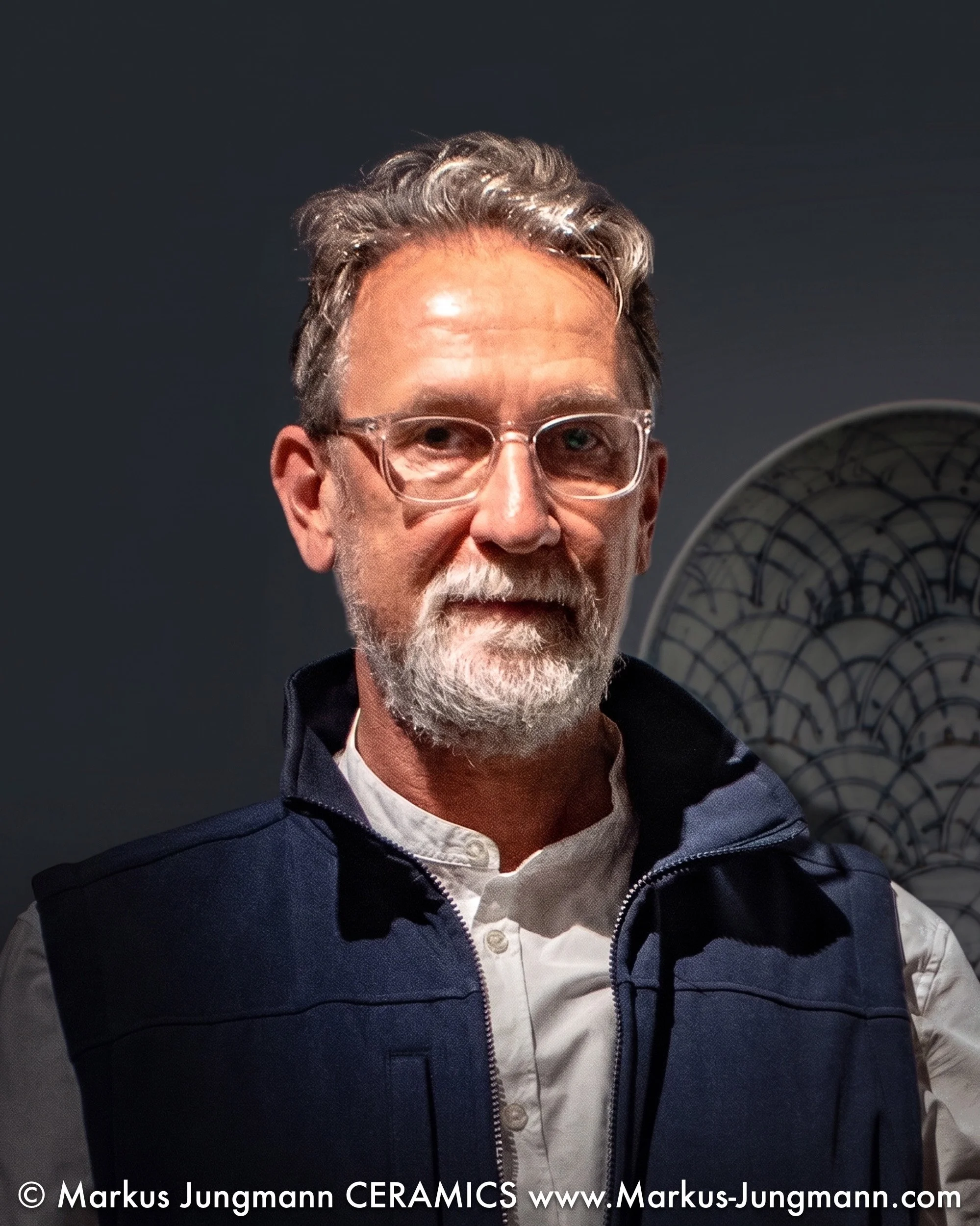
Markus’s studio is located in Ballygriffin 10 minutes from Kenmare. Workshop visits are welcome. To make an appointment please e-mail Markus@Markus-Jungmann.com or phone ahead of calling to the studio. Please find the address on the contact page. Or use the link on Google maps for directions.


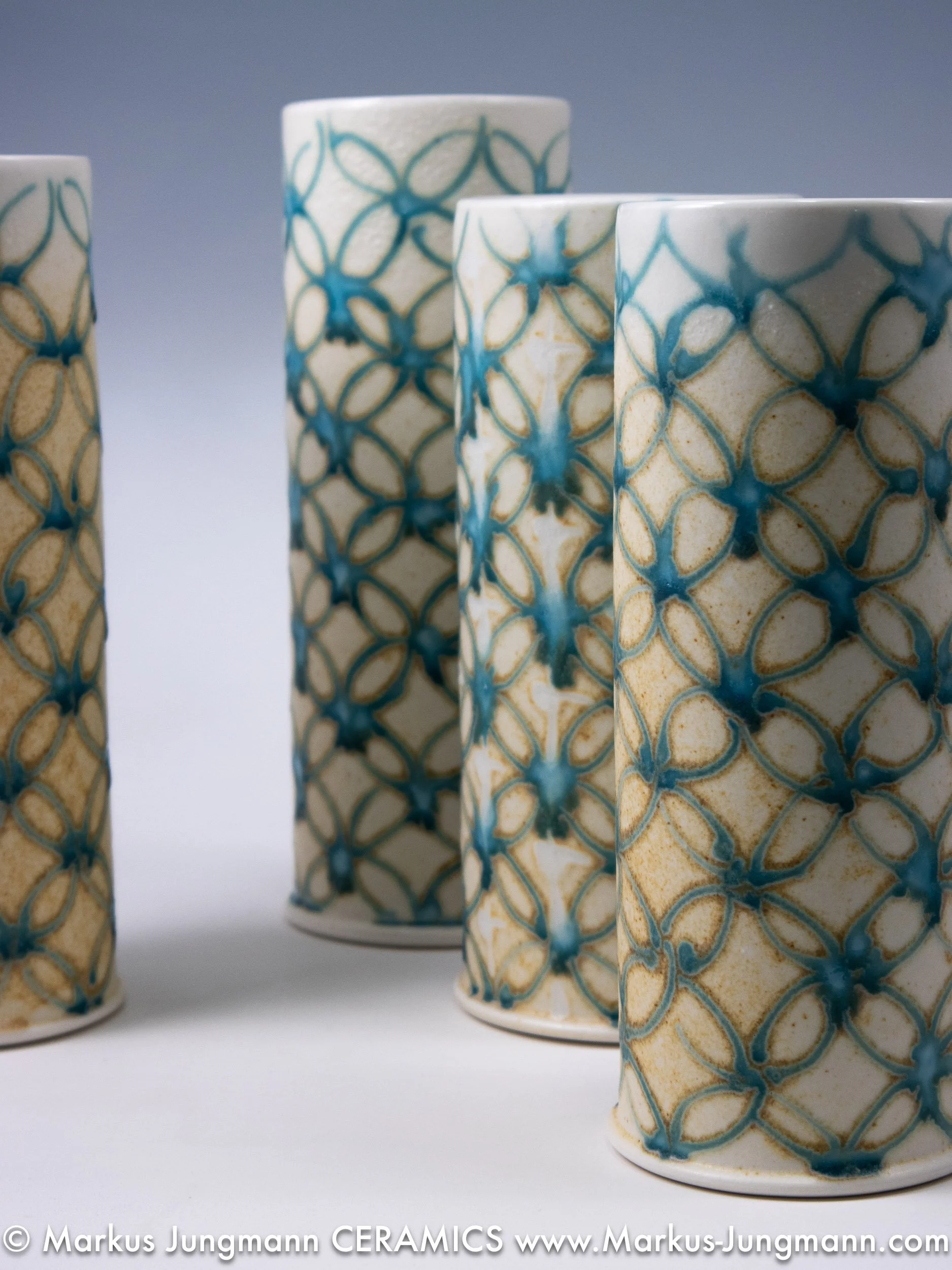


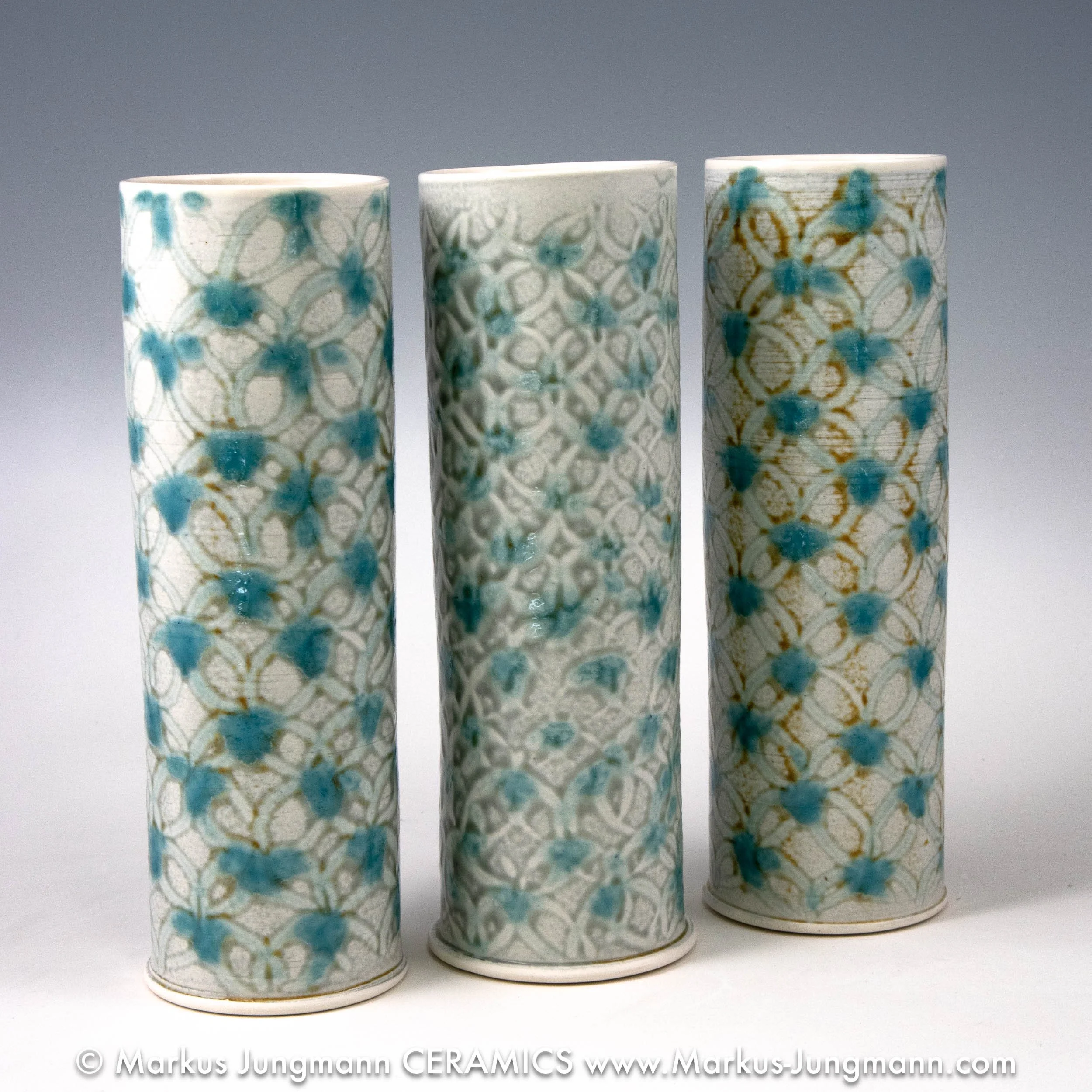







Collector’s Items and their background
Order and flow
Writing my Masters research back in the 90s, I came across the idea that pattern isn't only something we find in the world, it's something our perception will produce. Perception research treats such patterns as a small set of geometries the visual system produces on its own — a product of how it is wired, irrespective of any visual input. They can be triggered by gentle pressure on the eyeball and other such stimuli. I find this quite a parallel to how concepts and beliefs are shaping our reality.
In my personal experience, patterns appear with the eyes closed, often concentric circles. Sometimes they arrange themselves into more complex patterns, especially when listening to music, they can become three-dimensional structures.
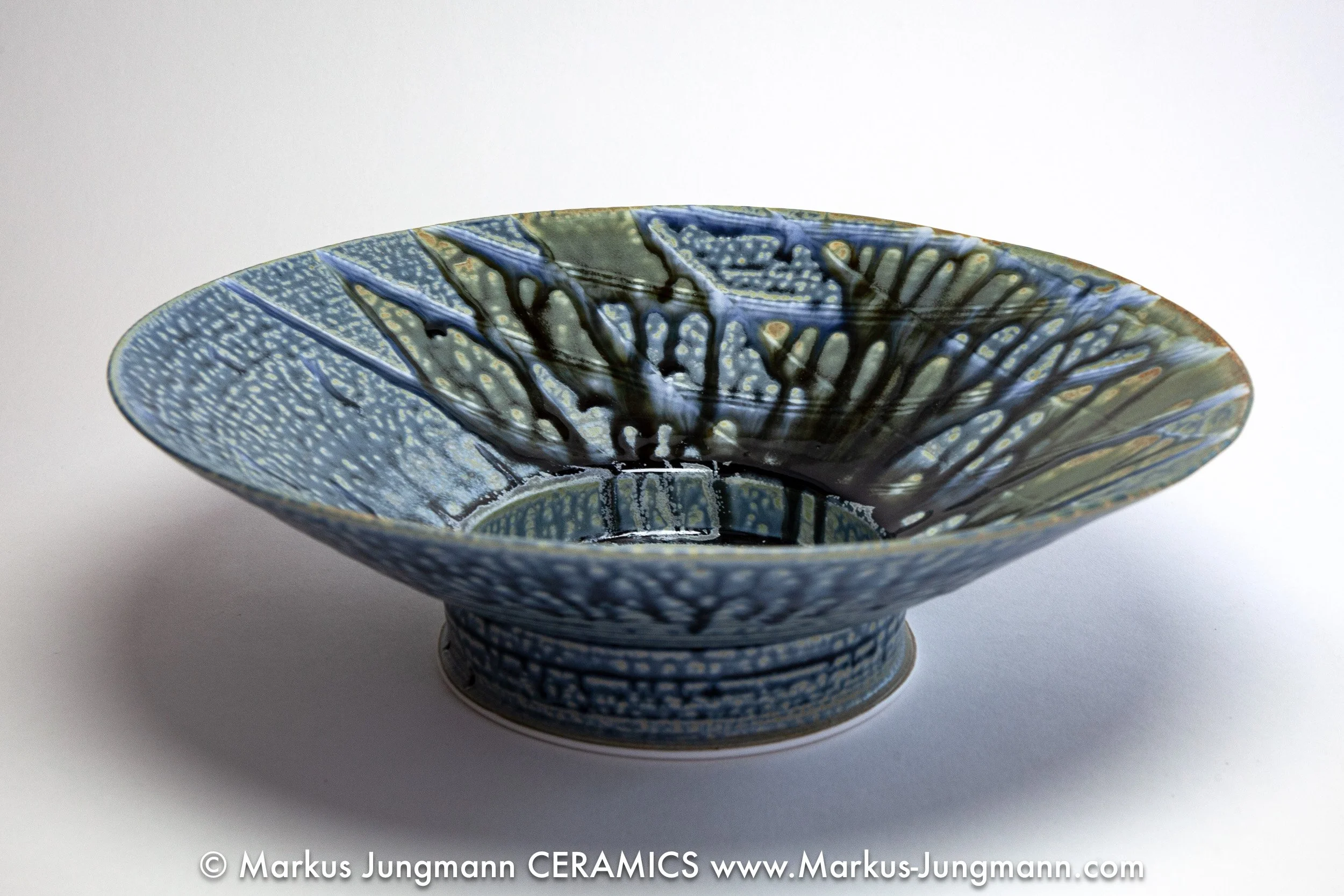
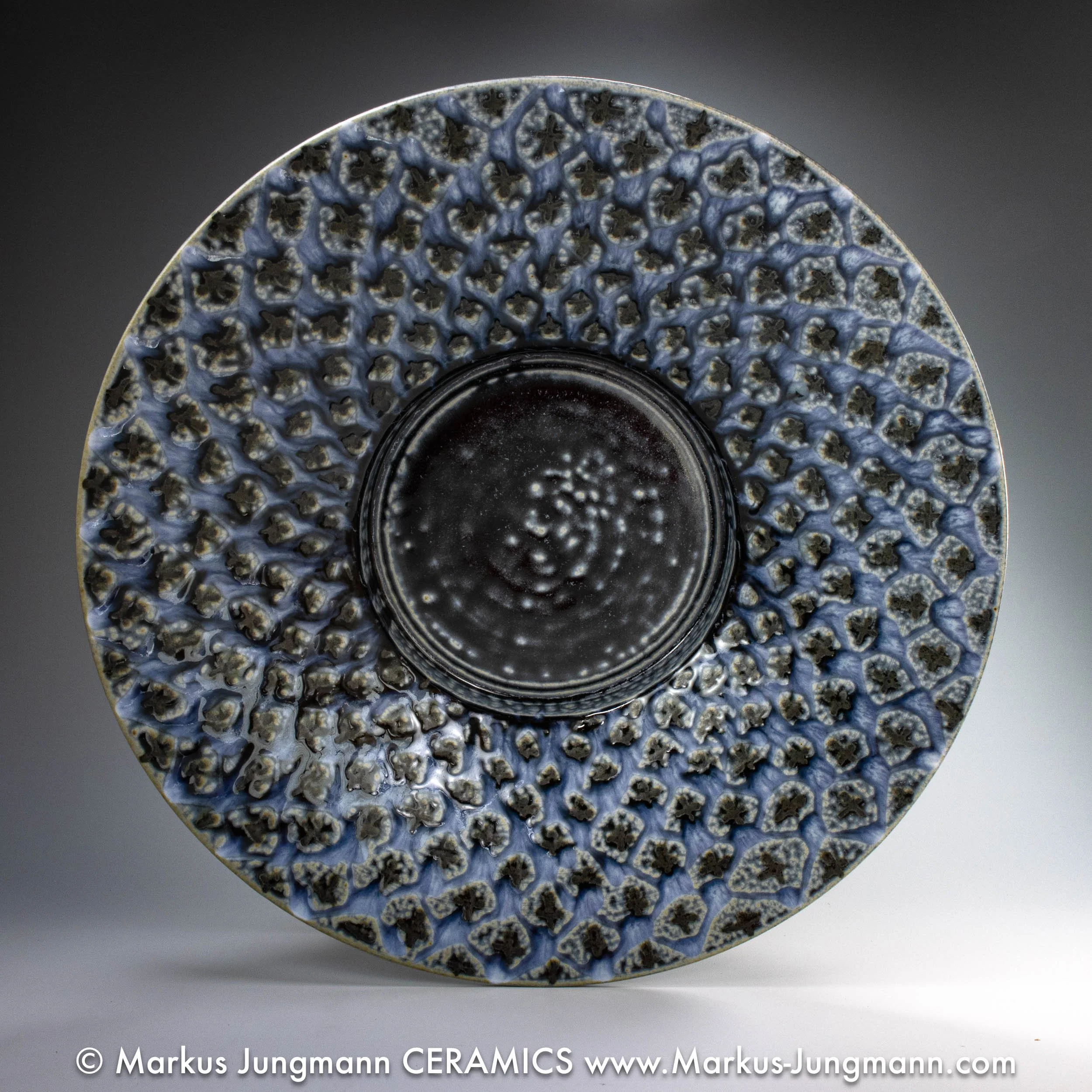
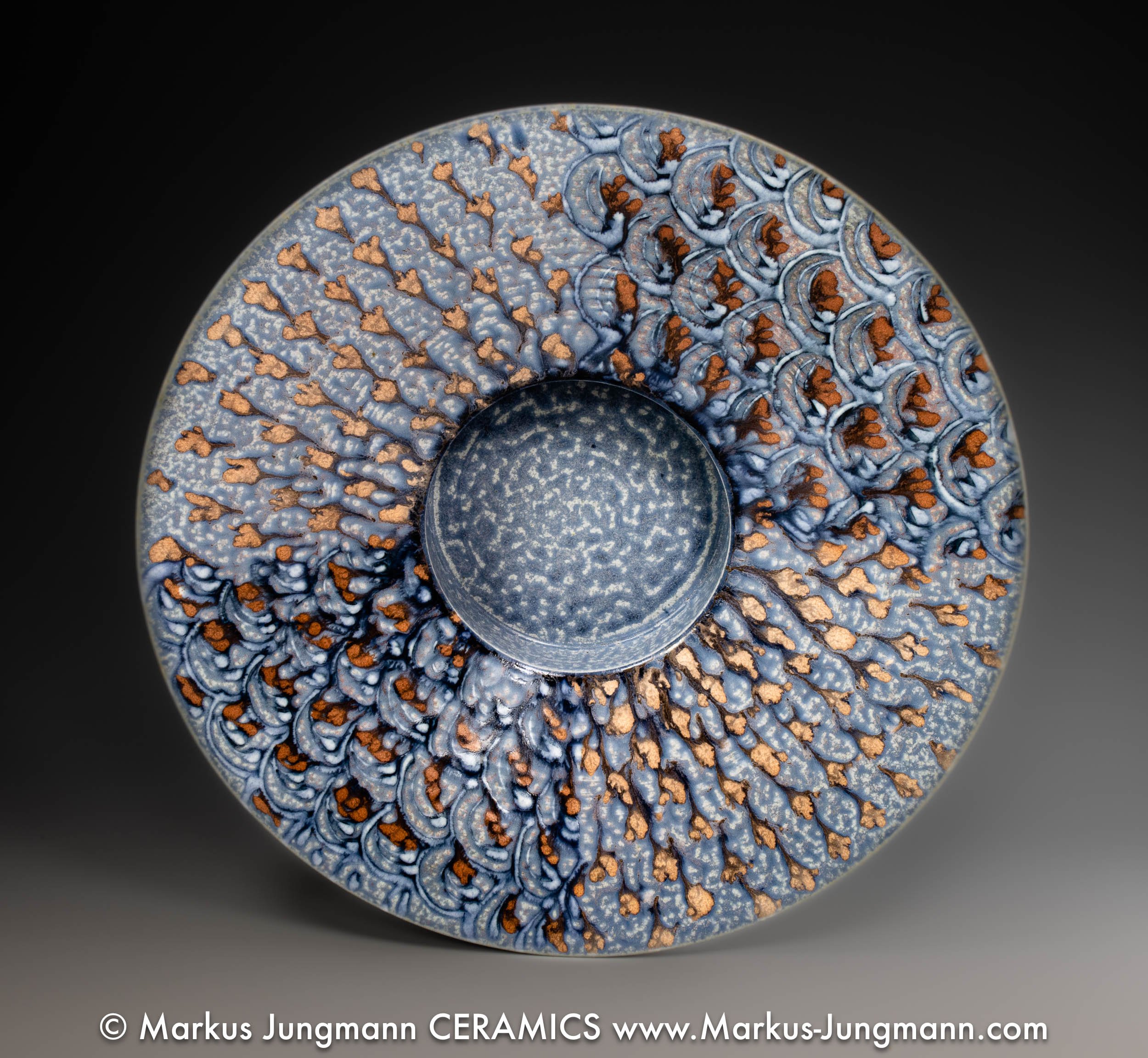
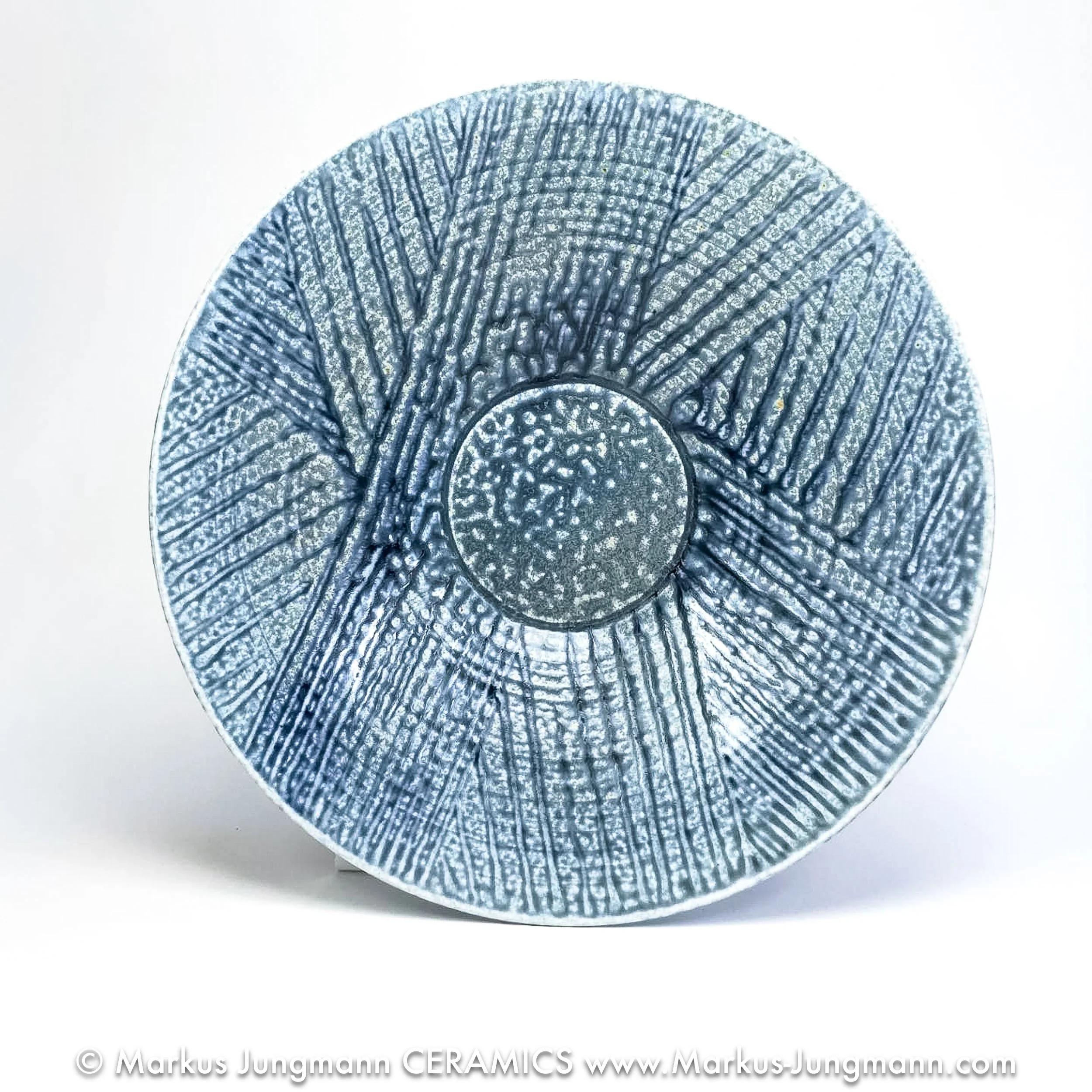
Having carried these ideas with me a long time, I saw a chance to work them out through a painterly use of glaze, on surfaces big enough to hold them, when I started exploring large wheel-thrown vessels in my current practice.
I set flowing pattern against gridlines, sometimes including them in the pattern, other times as the underlying structure, the grid, the order perception imposes. That order, although underlying all our perceptions, can be recognised for what it is — a helpful structure for orienting ourselves, but no more than that.
The patterns themselves can be helpful in resolving such rigid ordering. Concentrating on a fixed pattern can paradoxically free the mind from it. By satisfying the need for stability, the mind can drop its own attempts at holding steady and relax into flow. Some of my patterns work this way, holding their symmetry, circling and ordered, close in spirit to the cosmograms found across many cultures to settle the eye and mind. Others I break into sections and set against each other in dialogue.
Complementing the composition, I use the interaction of the glazes themselves to generate this interplay of order and flow. The pattern is trailed in a fluid glaze, sitting beneath a transparent ash glaze with high surface tension, which tugs against the order the pattern sets. The ash glaze is made with wood ash gathered locally, and in the firing the two react with each other. What comes out of the kiln is something I set going but never fully control. I bring the flow into the pattern; the fire adds its own.